NVIDIA Nemotron 3 Ultra: 550B MoE Open-Weights Model for Agents
NVIDIA unveils Nemotron 3 Ultra, a 550B hybrid Mamba+Transformer MoE with open weights, faster inference, lower cost, and long-horizon agent planning.
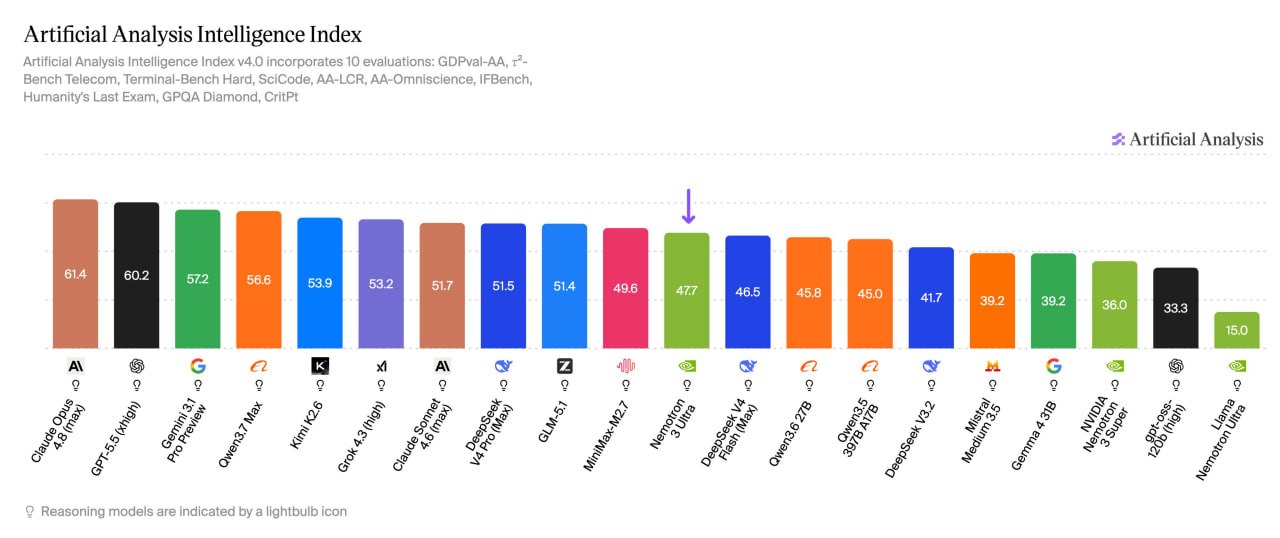
NVIDIA has released Nemotron 3 Ultra.
A 550B MoE model with open weights, tailored for long-lived agents.
According to NVIDIA:
• inference is up to 5× faster
• up to 30% cheaper on complex agent tasks
• stronger in programming, deep research, and long-term planning
The main focus is not on chats, but on agent scenarios where the model plans actions for hours, calls tools, handles errors, and makes decisions about next steps.
It uses a hybrid Mamba + Transformer MoE architecture, which makes it possible to run more reasoning cycles in the same amount of time.
Notable points:
• can work with large codebases
• maintains long chains of tool calls
• can collect and synthesize data from hundreds of sources
• was fine-tuned for OpenClaw, Hermes Agent, and LangChain
NVIDIA also opened not only the model weights, but also synthetic datasets along with post-training recipes.
And an immediate nice bonus.
Nous Research joined the Nemotron coalition and together with NVIDIA and Nebius opened free access to Nemotron 3 Ultra via Nous Portal for two weeks.
For those who want to run the model locally, GGUF quantizations from Unsloth have already appeared.
GGUF:
Guide: here

Comments
Weekly digest
The best of vibe coding, AI agents and open source — once a week, no spam.
Related articles
All articlesFree Agentic AI Textbook Download: Learn AI Agents Fundamentals
Download a free Agentic AI textbook covering planning, memory, tool use, decision-making, and multi-step execution—how agents differ from LLMs.
5 Open-Source No-Code Platforms for LLMs, RAG, and AI Agents
Explore 5 open-source no-code platforms to build LLM apps, RAG pipelines, and AI agents—AutoAgent, AnythingLLM, LangChain OAP, Sim, and Dify.
NVIDIA TwoTower Diffusion LLM Boosts Speed Without Losing Quality
Nemotron-Labs-TwoTower splits a 30B model into context and denoiser towers, enabling parallel block generation with 2.42× throughput and 98.7% quality.