
50 AI Agents Running 24/7: How OpenClaw Is Cleaning Up GitHub at Scale
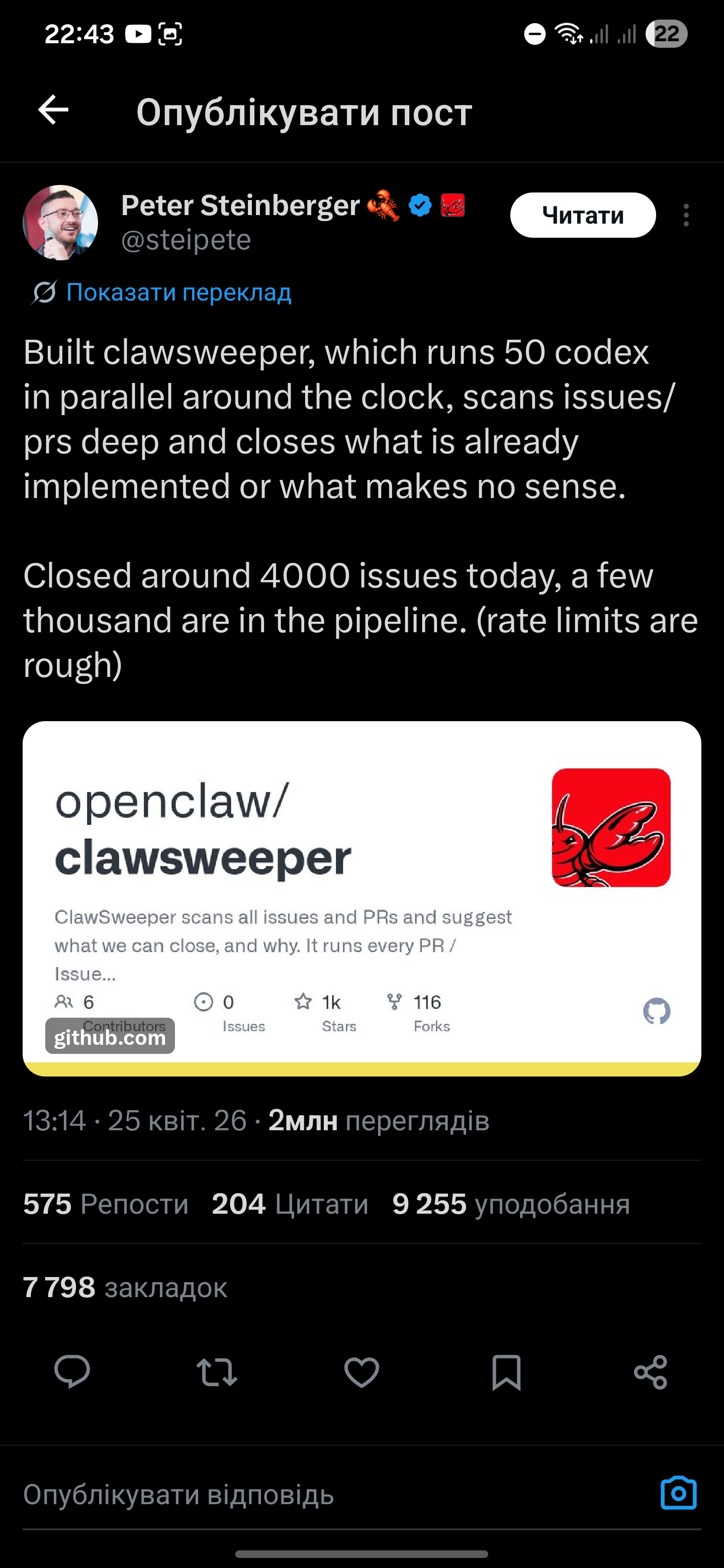
The way software is built and maintained is rapidly evolving — and AI is no longer just a helper, but an active participant. One striking example comes from OpenClaw, who demonstrated how massively parallel AI agents can transform GitHub workflows.
50 agents that never sleep
OpenClaw deployed a system of around 50 autonomous AI agents (powered by Codex-like models) running in parallel 24/7. Their job is simple in concept, but powerful in execution: continuously scan GitHub issues and pull requests.
These agents:
check whether issues are still relevant
detect duplicates
identify already implemented features
evaluate whether a task still makes sense
automatically close outdated or redundant issues
4,000 issues closed in a single day
The results are hard to ignore: roughly 4,000 issues closed in just one day — with minimal human involvement.
This leads to:
cleaner backlogs
faster access to high-priority work
reduced maintenance burden
better overall project hygiene
Not even the limit
According to Peter, the system could move even faster if it weren’t for API and compute limits.
That’s a strong signal that:
current performance is only the baseline
scaling could dramatically increase output
AI-driven repository maintenance is just getting started
What this means for developers
This approach fundamentally changes how open-source projects can be managed:
1. The end of “zombie issues”
AI can quickly identify and remove long-forgotten or irrelevant tasks.
2. Scalable open-source maintenance
Small teams can maintain large projects without expanding headcount.
3. Automated technical debt cleanup
AI becomes a constant “janitor” for repositories.
4. Less admin, more building
Developers can focus on writing code instead of managing issues.
Risks and open questions
Of course, this model isn’t without challenges:
potential false positives (closing valid issues)
trust in AI decisions
transparency of automation
community acceptance
What comes next: autonomous AI teams
OpenClaw’s experiment hints at a bigger shift — AI agents acting as real team members.
The next step could include:
agents writing and shipping code
automated PR reviews
AI-generated roadmaps based on user needs
Bottom line:
OpenClaw shows that large-scale automation of open-source maintenance is no longer theoretical. Today it's limited by infrastructure — tomorrow it could redefine how software is built and maintained.
https://x.com/i/status/2047982647264059734
github.com/openclaw/clawsweeper