Qwen3.8-Flash-Next: Open-Weight Model Beats Claude Opus 4.6 Max
Alibaba's Qwen3.8-Flash-Next, an open-weight model with 6B active params, beats Claude Opus 4.6 Max in coding and agentic tasks. From $0.16/M input tokens.
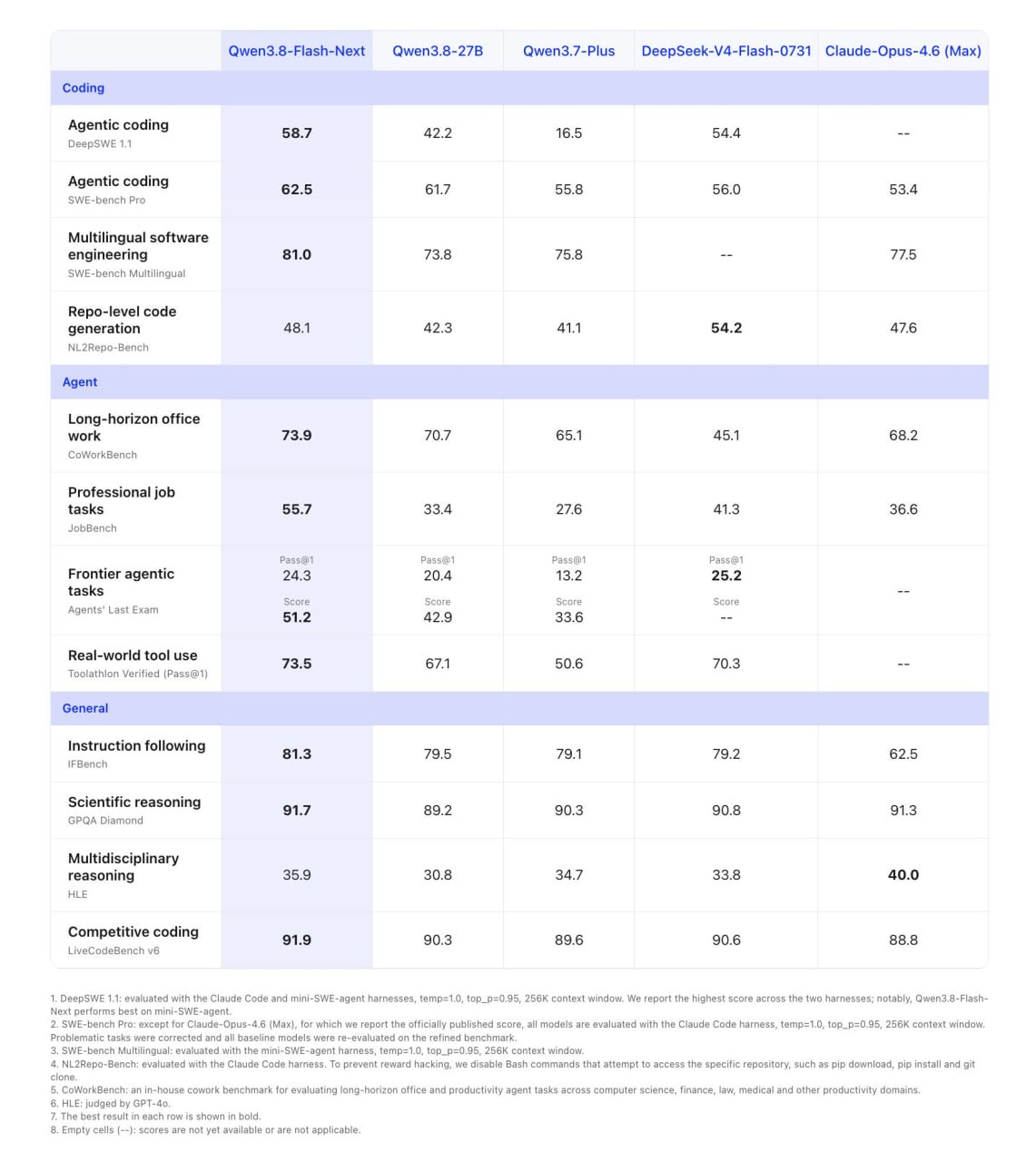
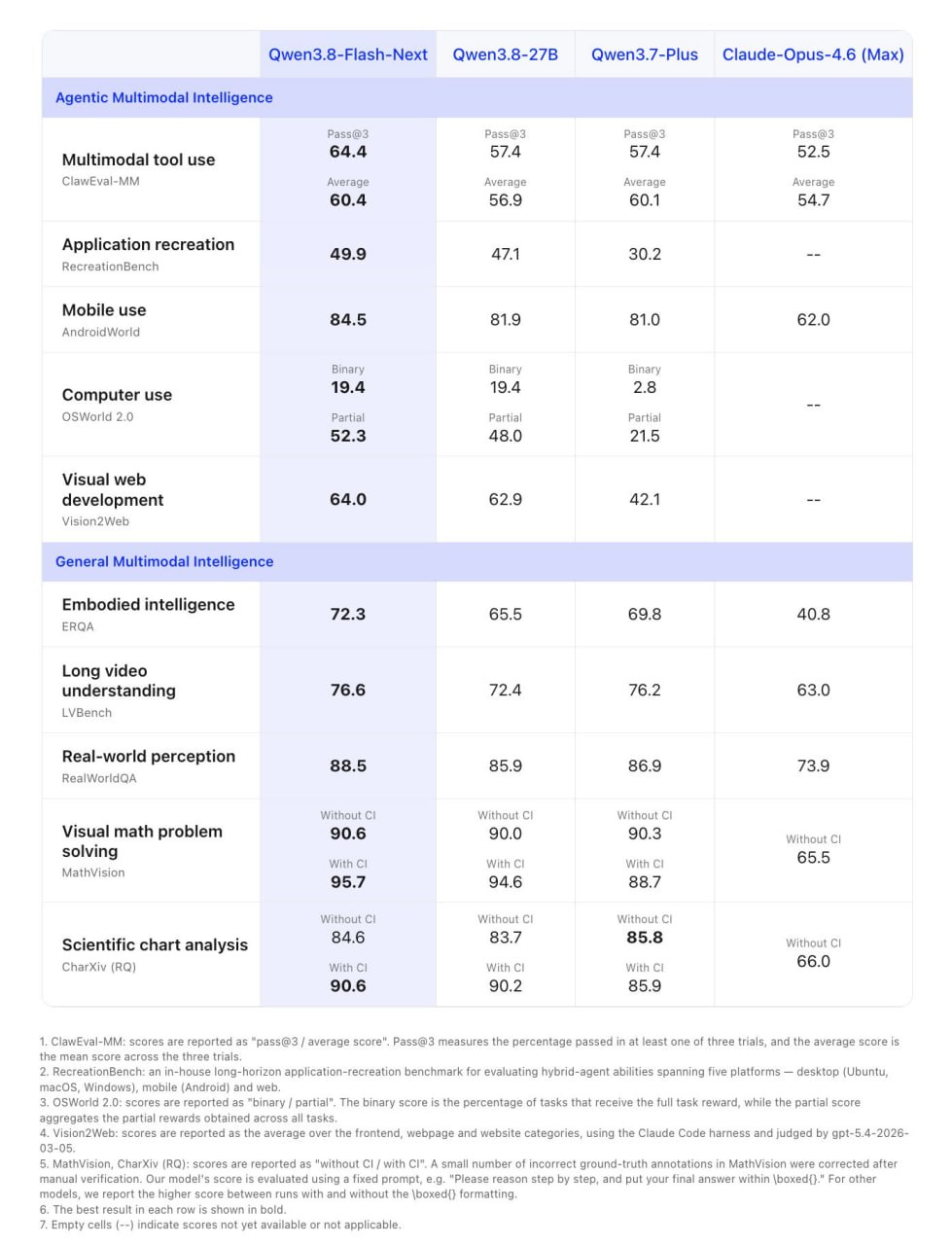
Alibaba introduced Qwen3.8-Flash-Next with weights, and it is already outperforming Claude Opus 4.6 Max in several tests at once.
This is not yet a full-fledged Qwen4, but an early preview of its architecture.
125 billion parameters in the base model plus 51 billion parameters of n-gram representations, with only 6 billion parameters activated per token.
Training cost roughly 9 times less than Qwen3.7-Plus, yet the model proved stronger in programming and office tasks.
Key results:
• SWE-bench Pro — 62.5 vs 53.4 for Claude Opus 4.6 Max
• SWE-bench Multilingual — 81.0
• CoWorkBench — 73.9
• JobBench — 55.7
• Toolathlon — 73.5
• LiveCodeBench — 91.9
• GPQA Diamond — 91.7
• IFBench — 81.3
Native context of 256K tokens, expandable to 1 million via YaRN.
On a 1 million token context, preprocessing speeds up by up to 7.6 times, and generation by up to 4.9 times.
Only 6 billion active parameters per token, yet the level is already comparable to Opus in agentic tasks and programming.
Very soon the model will be available via API at $0.16 per 1 million input tokens and $0.47 per 1 million output tokens.

Comments
Weekly digest
The best of vibe coding, AI agents and open source — once a week, no spam.
Related articles
All articleszvec: Lightweight Local Vector Search for Your Own Knowledge Base
Alibaba’s open-source zvec embeds vector search like SQLite—no servers. Fast hybrid vector + full-text search, on-disk index, and Zvec Studio.
MiniMax Code Goes Open Source: Performance Beats Codex & Claude
MiniMax Code is now open on GitHub, offering faster, cheaper AI coding with 76.7% success—outperforming Codex and Claude Code.
Alibaba Qwen3.6-35B-A3B: Sparse MoE Model with 3B Active Params
Alibaba’s Qwen3.6-35B-A3B is a sparse MoE with 3B active params, strong coding and multimodal vision results, plus GGUF for local 4-bit runs.