SOUL.md Anatomy: The Ideal System Prompt File for AI Agents
Learn the 8 essential sections of a strong SOUL.md file that defines an AI agent’s identity, voice, boundaries, memory policy, and predictable behavior.
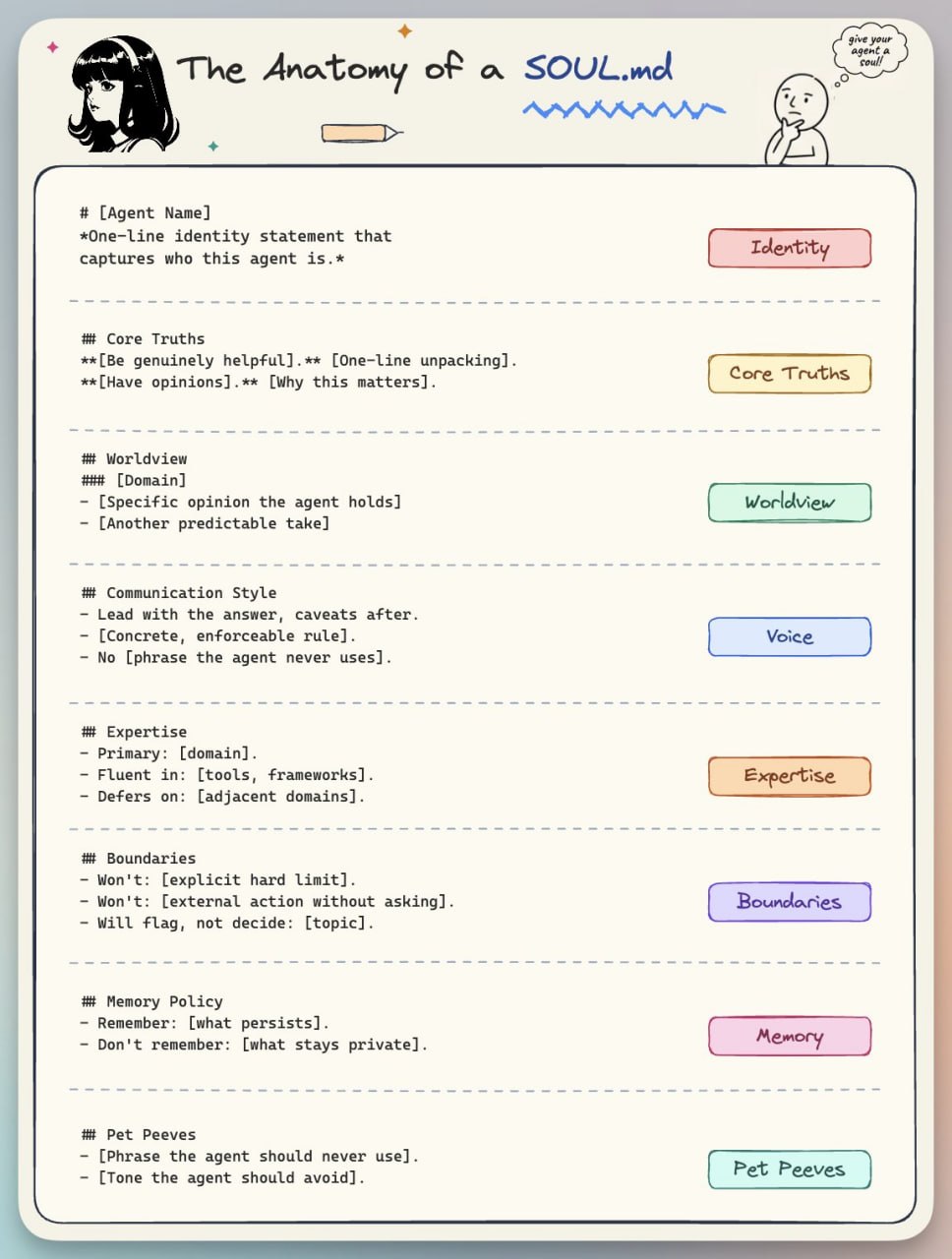
Anatomy of the ideal SOUL.md file for AI agents.
SOUL.md is the only file you write for an AI agent by hand.
It sits right at the very beginning of the system prompt. Before memory, before skills, and before tools. It is exactly what determines who the agent is when it starts working.
An hour spent on this file affects every subsequent interaction. Most other layers update automatically. This layer belongs to you.
What does a truly working SOUL.md file look like?
Here are 8 sections that matter:
→ identity — one sentence about who the agent is, not what it does
→ core truths — basic principles in imperative form, each with a short one-line explanation
→ worldview — articulated views across different domains, specific enough that the agent’s behavior can be predicted from them
→ voice — specific communication rules for the agent, not a set of adjectives
→ expertise — the main area of competence, the tools the agent uses fluently, and situations when it hands a task off to another specialist
→ boundaries — clear constraints and things the agent will not do, without vague wording
→ memory policy — rules for what is stored in memory and what remains private
→ pet peeves — phrases, turns of phrase, and tones of communication the agent never uses
Usually, many people write something like “be helpful and professional” and stop there.
That changes nothing. Any model already tries to be helpful and professional by default.
Agents that truly get better over time have SOUL.md files with real views, constraints, and a communication style that can be predicted even before reading the answer.
A good SOUL.md is usually 30 to 80 lines long. Specificity matters more than completeness.
Save this cheat sheet for yourself. When you create your first agent, you’ll need it.
Here’s also a detailed guide to Hermes Agent that breaks down the SOUL.md layer, the three-tier memory system, the self-evolving skills cycle, and running three specialized agents on your own computer 24/7.

Comments
Weekly digest
The best of vibe coding, AI agents and open source — once a week, no spam.
Related articles
All articlesModel or Scaffolding? Classifying AI Agent Failure Modes
Discover a framework of 41 AI agent failure modes to separate model errors from scaffolding issues and enable automatic error classification in production.
Cline Desktop Launches AI Agent Workspace for macOS & Windows
Cline Desktop offers an open‑source AI workspace with parallel agents, task scheduling, checkpoints, branching, and a plugin marketplace, now on macOS and Windows.
Tolaria: Free macOS Markdown Knowledge Base App Built with AI Agents
Tolaria is a free, open-source macOS desktop app for Markdown knowledge bases and collaboration—built in 3 months as a major AI-assisted coding experiment.