Model or Scaffolding? Classifying AI Agent Failure Modes
Discover a framework of 41 AI agent failure modes to separate model errors from scaffolding issues and enable automatic error classification in production.
Model or scaffolding?
If you are developing AI agents for production, this article is worth saving.
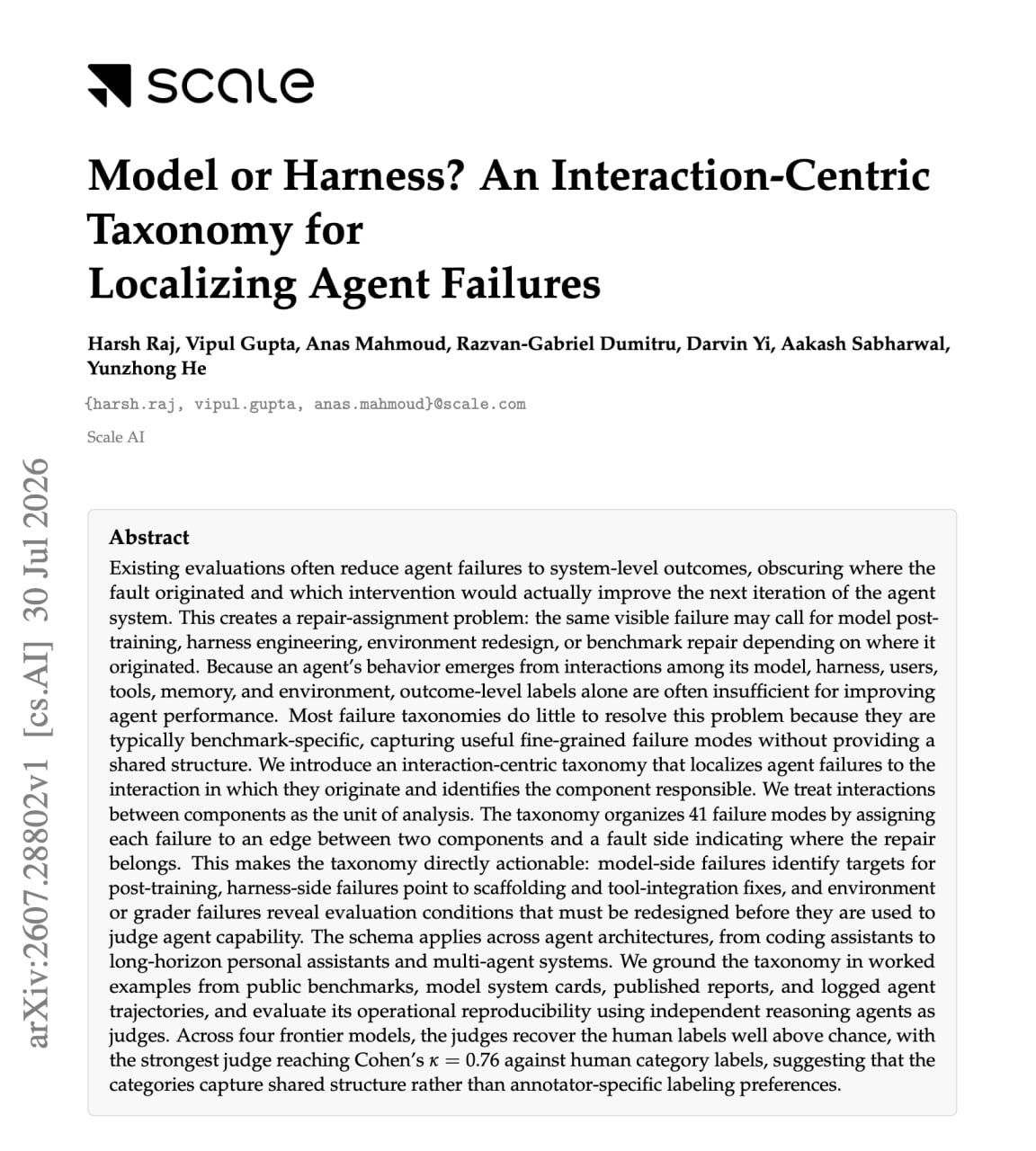
The authors collected 41 typical failure scenarios and classified them by where, at the junction of which components, the problem arises. Each error is tied to the interaction between the model, the scaffolding, the user, the tools, the memory, or the environment, and also indicates on whose side the cause lies and where it needs to be fixed.
This accurately reflects the real picture: most AI agent problems arise not in the model itself, but at the junction of the model and the surrounding infrastructure.
The approach is also suitable for automatic analysis. In tests on four frontier models, the best AI judge achieved a Cohen’s kappa of 0.76 compared to manual annotation. This makes it possible to automatically classify errors directly in production, rather than sorting them out manually after each incident.
This year, scaffolding engineering has become one of the main factors in AI agent quality, but there has still been no common language to distinguish model errors from scaffolding errors. This work proposes exactly such a system.
Article: https://arxiv.org/abs/2607.28802

Comments
Weekly digest
The best of vibe coding, AI agents and open source — once a week, no spam.
Related articles
All articlesDesign the Loop Before Launching /goal to Save Tokens and Improve Output
Use the LOOPER skill to critique your /goal loop, set rubrics and budgets, add LLM judges, and export a reusable loop artifact with a diagram.
Shepherd: Stanford’s Git-Like Rollback System for AI Agents
Stanford’s open-source Shepherd lets AI agents roll back to the last correct step, reuse up to 95% of prior compute, and auto-recover from errors.
SOUL.md Anatomy: The Ideal System Prompt File for AI Agents
Learn the 8 essential sections of a strong SOUL.md file that defines an AI agent’s identity, voice, boundaries, memory policy, and predictable behavior.